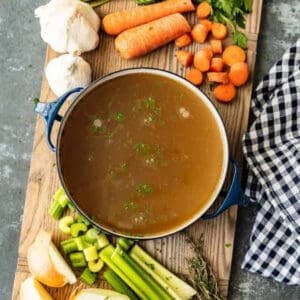
Homemade Chicken Broth Recipe
This homemade chicken broth is so easy and tasty, you'll be making your own all the time. Use it for any soup or recipe that calls for it!
Servings: 19 cups
Calories: 102kcal
Ingredients
- 2 (5-pound) whole young roasting chickens *
- 3 large yellow onions unpeeled and quartered**
- 1 head garlic unpeeled and halved, optional
- 6 large carrots washed, unpeeled and quartered
- 4 ribs celery with leaves washed and halved
- 2 tablespoons herbes de Provence
- 4 dried bay leaves
- 12 whole cloves
- 2 teaspoons whole black peppercorns
- 1 tablespoon kosher salt
- 1 tablespoon low-sodium soy sauce
- 6 quarts cold water
Instructions
- Place all ingredients in a 16-20 quart stockpot, and cover with 6 quarts of water.2 (5-pound) whole young roasting chickens, 6 quarts cold water, 3 large yellow onions, 1 head garlic, 6 large carrots, 4 ribs celery with leaves, 2 tablespoons herbes de Provence, 4 dried bay leaves, 12 whole cloves, 2 teaspoons whole black peppercorns, 1 tablespoon kosher salt, 1 tablespoon low-sodium soy sauce

- Bring to a boil, reduce heat to low, and simmer uncovered for 2½ hours.

- Carefully transfer the chickens to two large bowls. Remove the chicken meat from the bones and set aside.

- After removing the meat from the bones, place the bones and the excess broth (from the bones) back into the stockpot. Season to taste – the broth should taste lightly salted.

- Continue cooking the chicken broth another 1½ hours.

- While the broth reduces, cut or shred the chicken meat and save for other meals. (It freezes beautifully.)
- After the broth is finished cooking, strain it through a colander, and discard the remaining solids.

- Refrigerate the broth overnight, then remove the surface fat the next day.

- The broth will be slightly gelatinous, but it will liquefy and add a rich, lovely flavor when heated.

Video
Notes
Yield: 19 cups chicken broth + 4 cups cooked chicken.
*I like young roasting chickens since they are relatively small and fit in a stock pot well. You can also part out the chicken to fit or use a mix of bone-in thighs, legs, breasts, wings, necks, and backs.
**Use your scraps! If you have leftover onion or celery ends and/or carrot tops (or peeled skins), save them in a Ziplock bag in the freezer to use in future batches of broth. It's such a great way to use up what otherwise goes to waste.
Tips:
- This is my favorite spice blend for a warm and balanced broth that works well in all kinds of dishes. To spice up this broth, add in some crushed red pepper or chilis.
- This broth is what I would call "reduced sodium". It's naturally much lower in sodium than store-bought, but it is not "low sodium" by definition. A truly low-sodium broth should have 140mg or less of sodium per 1-cup serving.
- To further reduce the sodium content, you can reduce the amount of salt and/or soy sauce used.
- You can simmer this broth for up to 8 hours, but I always recommend removing the chicken meat at 2½ hours so it doesn't get overcooked.
- To easily remove the meat from the bones, pull the chicken apart with your hands so that the wings, body, legs, and thighs are all separate. Then pull the white meat off the body, keeping the pieces as large as possible. Don't forget about the wing joints and wishbones as well — there's good meat hiding in there!
- The longer you cook the broth, the more concentrated the flavor will be, the more collagen it will have, and the more gelatinous it will set up in the fridge.
- Don't throw out the fat! The fat is not only highly nutritious but is excellent for preventing freezer burn when stored in the freezer. It is also a useful ingredient for sauteeing your leftover veggies.
- Nutritional information is for the broth only, not the cooked chicken.
Nutrition
Serving: 1cup | Calories: 102kcal | Carbohydrates: 6g | Protein: 1g | Fat: 9g | Saturated Fat: 3g | Polyunsaturated Fat: 2g | Monounsaturated Fat: 4g | Trans Fat: 0.001g | Cholesterol: 7mg | Sodium: 437mg | Potassium: 150mg | Fiber: 2g | Sugar: 2g | Vitamin A: 3869IU | Vitamin C: 4mg | Calcium: 41mg | Iron: 1mg